

Jewelry Glossary
Master the language of jewelry with essential terms and definitions from industry experts
Understanding Jewelry Terminology
The world of jewelry has its own rich vocabulary developed over centuries of craftsmanship and tradition. Understanding these terms empowers you to make informed decisions, communicate effectively with jewelers, and appreciate the artistry behind each piece.
Expert Tip: This glossary covers essential terms you'll encounter when shopping for engagement rings, wedding bands, and fine jewelry. Bookmark this page for quick reference!
A - C
Alloy
A mixture of two or more metals. Pure gold (24k) is too soft for jewelry, so it's mixed with other metals like copper, silver, or palladium to create durable alloys like 14k or 18k gold.
Appraisal
A professional evaluation of jewelry's quality, authenticity, and monetary value, typically required for insurance purposes. Should be performed by a certified gemologist.
Bezel Setting
A setting where the gemstone is completely surrounded by a metal rim, providing excellent security and a sleek, modern appearance. Popular for active lifestyles.
Brilliant Cut
The most popular diamond cut featuring 58 facets designed to maximize light reflection and sparkle. Also called round brilliant cut.
Carat
The unit of weight for gemstones. One carat equals 200 milligrams. Not to be confused with "karat," which measures gold purity.
Certificate
An official document from a gemological laboratory (like GIA) that details a diamond's characteristics including the 4Cs, measurements, and any treatments.
Channel Setting
A setting where small diamonds are placed in a continuous row within a channel of metal, creating a smooth, uninterrupted line of sparkle.
Clarity
One of the 4Cs referring to the presence of internal inclusions or external blemishes in a diamond. Graded from FL (Flawless) to I3 (Included).
D - F
Diamond Proportion
The relationship between a diamond's dimensions that affects its brilliance and fire. Includes table percentage, depth percentage, and crown/pavilion angles.
Durability
A gemstone's ability to withstand wear, measured by hardness (resistance to scratching), toughness (resistance to breaking), and stability (resistance to chemicals/heat).
Emerald Cut
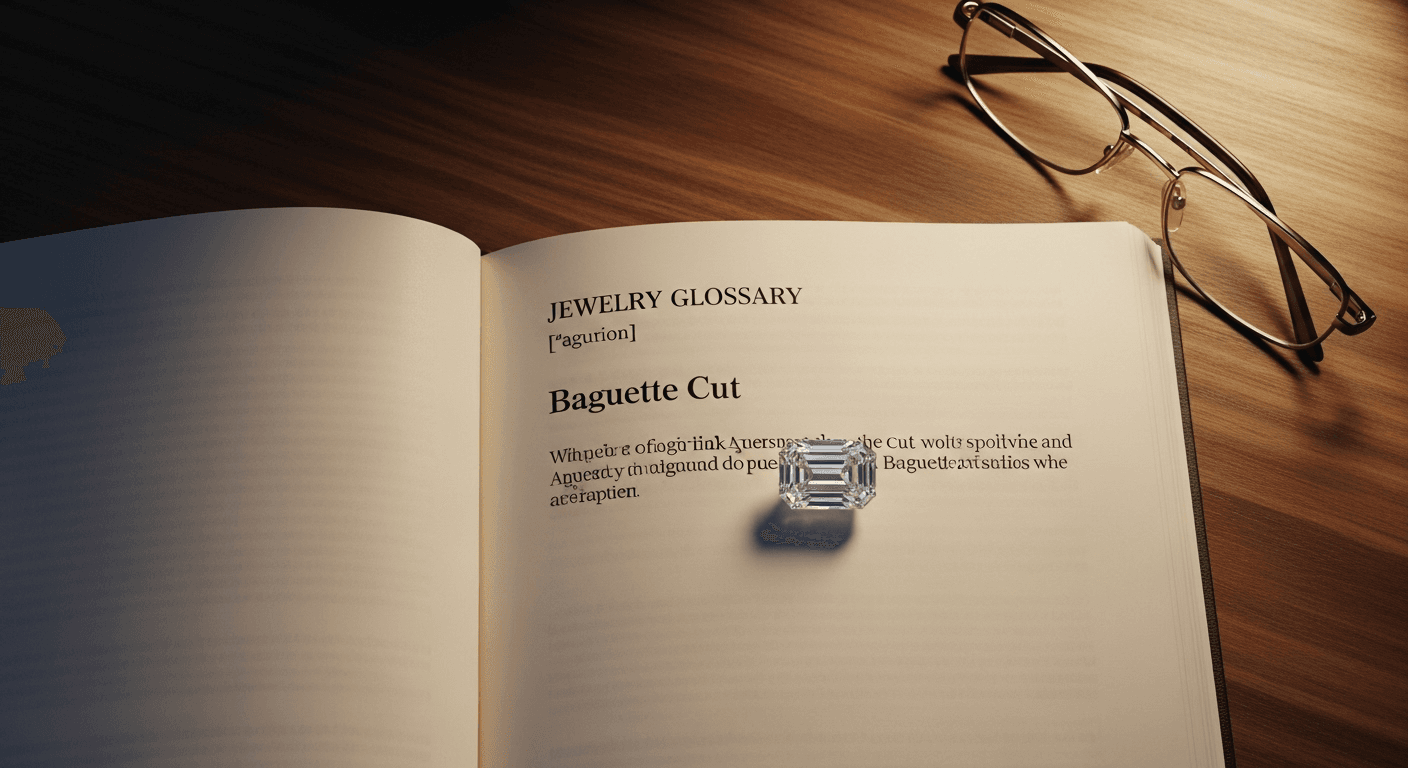
A rectangular step-cut diamond with cropped corners, featuring broad, flat planes that create a hall-of-mirrors effect. Emphasizes clarity over brilliance.
Engagement Ring
A ring given during a marriage proposal, traditionally featuring a prominent diamond or gemstone. Typically worn on the left ring finger.
Facet
A flat, polished surface on a gemstone. The number, size, and angles of facets determine how light interacts with the stone, affecting its brilliance.
Fire
The dispersion of white light into spectral colors (rainbow flashes) as it passes through a diamond. More noticeable in well-cut diamonds with good proportions.
Fluorescence
A diamond's tendency to emit visible light when exposed to ultraviolet radiation. Can range from none to very strong, typically appearing blue.
G - I
GIA
Gemological Institute of America - the world's most respected gemological laboratory, known for developing the 4Cs grading system and providing diamond certificates.
Girdle
The narrow band around the widest part of a diamond where the crown meets the pavilion. Can be polished, faceted, or bruted (rough).
Halo Setting
A setting where the center stone is surrounded by a circle of smaller diamonds, making the center stone appear larger and adding extra sparkle.
Inclusion
Internal characteristics within a gemstone, such as crystals, clouds, or fractures. These natural features affect clarity grading and can impact a stone's durability.
Invisible Setting
A technique where diamonds are set so closely together that no metal is visible between them, creating the appearance of one continuous diamond surface.
J - P
Karat (K)
A measure of gold purity. 24k is pure gold, 18k is 75% gold, 14k is 58.3% gold. Higher karat gold is softer and more valuable but less durable.
Lab-Grown Diamond
A diamond created in a laboratory using high pressure/temperature or chemical vapor deposition. Chemically identical to natural diamonds but typically less expensive.
Marquise Cut
An elongated diamond shape with pointed ends, resembling a football or boat. Maximizes carat weight and creates the illusion of longer, more slender fingers.
Mounting
The metal framework that holds a gemstone in place. Also called a setting, it includes the head, shank, and any decorative elements.
Pavilion
The lower portion of a diamond below the girdle. The pavilion's angles and depth significantly impact the diamond's brilliance and light performance.
Prong Setting
The most common setting style using metal claws (prongs) to hold a gemstone. Typically uses 4 or 6 prongs, allowing maximum light to enter the stone.
Q - Z
Rhodium Plating
A thin coating of rhodium (a platinum family metal) applied to white gold jewelry to enhance its white color and provide scratch resistance.
Scintillation
The sparkle or flashes of light that appear when a diamond or gemstone moves. Created by the contrast between light and dark areas within the stone.
Solitaire
A ring featuring a single gemstone, typically a diamond, without additional accent stones. The classic engagement ring style that emphasizes the center stone.
Table
The large, flat facet on the top of a diamond. Table percentage (table width relative to girdle diameter) affects the diamond's brilliance and fire.
Tiffany Setting
A classic solitaire setting with a high mounting and six prongs, designed by Tiffany & Co. in 1886. Maximizes light exposure to the diamond.
Wedding Band
A ring exchanged during the wedding ceremony, traditionally a simple band worn alongside the engagement ring to symbolize the marriage union.
Quick Reference
Most Searched Terms
- •Certificate vs. Appraisal
- •Carat vs. Karat
- •Lab-Grown vs. Natural
- •Setting Types
- •Diamond Shapes
Expert Resources
Need clarification on a specific term? Our certified gemologists are here to help.
Response time: Within 24 hours
Consultation: Free for customers
Ready to Apply Your Knowledge?
Now that you understand the language of jewelry, explore our collection and speak with confidence.