

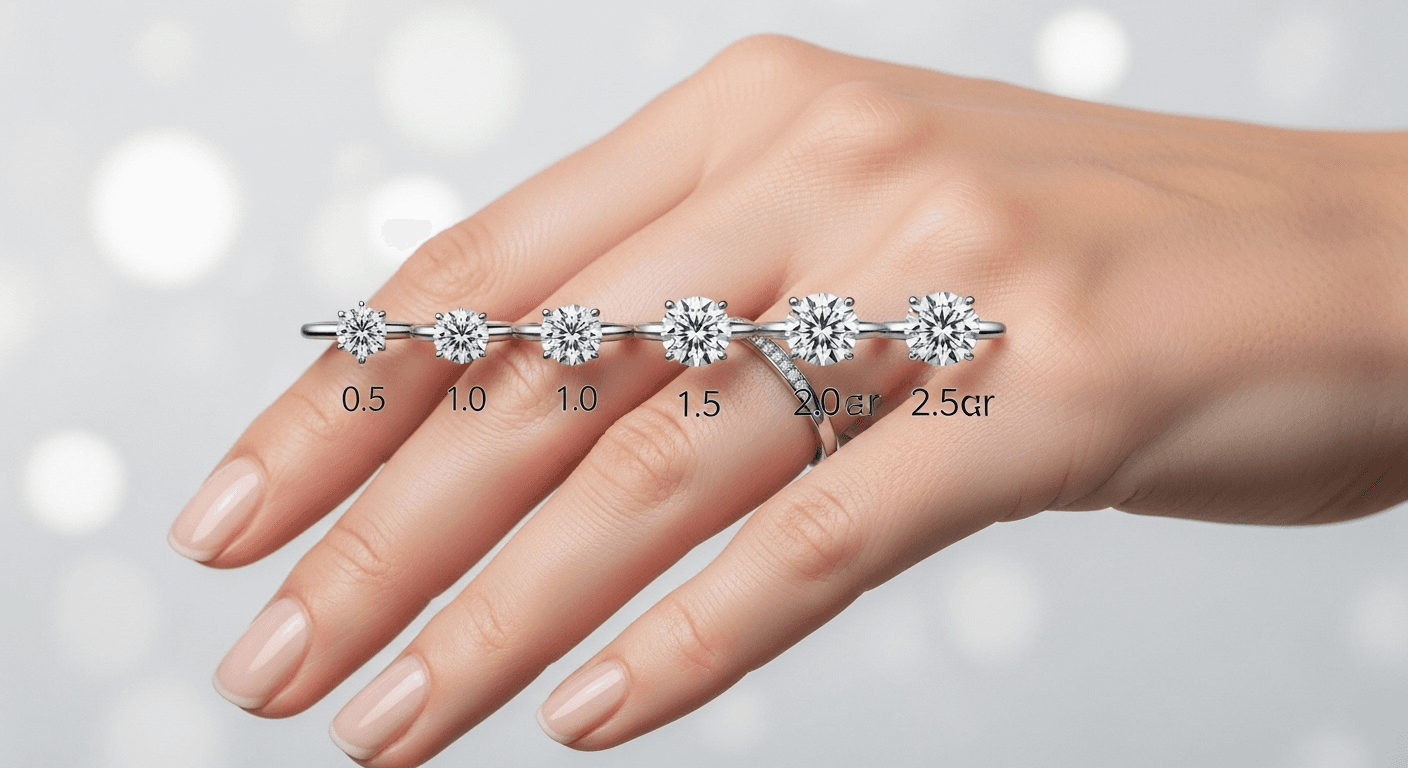
Carat Guide
Master the relationship between carat weight, size appearance, and value in ring selection
Carat weight is one of the most significant factors affecting a ring's price and visual impact. Understanding how carat weight relates to size appearance and value will help you make the smartest choice for your budget and style preferences.
Understanding Carat Weight
What is Carat Weight?
Carat is the unit of measurement for a gemstone's weight. One carat equals 200 milligrams or 0.2 grams, and it's divided into 100 points.
Carat Measurements
- • 1 carat = 100 points = 200 milligrams
- • 0.50 carat = 50 points
- • 0.25 carat = 25 points
- • 0.10 carat = 10 points
Historical Context
The word "carat" comes from the carob seed, which ancient gem traders used as a standard weight due to its uniform mass.
Weight vs. Size
Carat weight doesn't directly translate to visual size. Cut quality, shape, and proportions significantly affect how large a stone appears.
Factors Affecting Apparent Size
- • Cut quality and proportions
- • Diamond shape and outline
- • Table percentage and depth
- • Setting style and height
Optimization Tips
- • Choose excellent cut grades
- • Consider elongated shapes
- • Select appropriate setting styles
- • Focus on face-up appearance
Popular Carat Weight Ranges
Under 0.50 Carat
Perfect for delicate, everyday wear or as accent stones. Excellent value and subtle elegance for budget-conscious buyers.
Popular Sizes
- • 0.25 carat (quarter carat)
- • 0.33 carat (one-third carat)
- • 0.40 carat
- • 0.45 carat
Best For
- • First-time buyers
- • Delicate hand sizes
- • Budget under $3,000
- • Stackable ring styles
0.50 - 0.99 Carat
The sweet spot for many buyers. Good size presence with reasonable pricing. Offers excellent balance of impact and value.
Popular Sizes
- • 0.50 carat (half carat)
- • 0.70 carat
- • 0.75 carat (three-quarter carat)
- • 0.90 carat
Advantages
- • Noticeable size presence
- • Good value proposition
- • Wide setting options
- • Practical for daily wear
1.00 - 1.49 Carat
The coveted one-carat milestone and beyond. Significant presence and status, representing a major investment in quality and beauty.
Milestone Weights
- • 1.00 carat (one carat)
- • 1.25 carat
- • 1.33 carat
- • 1.50 carat
Considerations
- • Premium pricing at 1.00ct
- • Significant visual impact
- • Requires quality in all 4Cs
- • Insurance considerations
1.50+ Carat
Luxury territory with exceptional presence and rarity. These sizes command premium prices and require careful selection for quality.
Luxury Sizes
- • 1.50 carat
- • 2.00 carat
- • 2.50 carat
- • 3.00 carat and beyond
Investment Factors
- • Exponential price increases
- • Rarity and exclusivity
- • Premium quality requirements
- • Comprehensive insurance needs
Carat Weight and Pricing
Price Per Carat Concept
Diamond pricing is based on price per carat, which increases exponentially at certain weight thresholds due to rarity and demand.
Major Price Jumps
- • 0.30 carat threshold
- • 0.50 carat milestone
- • 0.70 carat level
- • 1.00 carat premium
- • 1.50, 2.00, 3.00 carat levels
Smart Buying Strategies
Buy Just Under Milestones
Consider 0.90ct instead of 1.00ct, or 1.80ct instead of 2.00ct for significant savings with minimal visual difference.
Focus on Cut Quality
A well-cut 0.80ct diamond can appear larger than a poorly cut 1.00ct diamond while costing significantly less.
Consider Shape Impact
Elongated shapes like oval, pear, or marquise can appear 10-15% larger than round diamonds of the same carat weight.
Carat Weight by Hand Size
Petite Hands (Size 4-5)
Smaller hands can be overwhelmed by very large stones. Focus on proportional sizing for elegant, comfortable wear.
Recommended Ranges
- • 0.25 - 0.75 carat range
- • Delicate, refined settings
- • Consider elongated shapes
- • Avoid overly wide bands
Average Hands (Size 6-7)
Most versatile size range that can accommodate various carat weights beautifully. Wide range of options available.
Recommended Ranges
- • 0.50 - 1.50 carat range
- • All shapes work well
- • Flexible setting options
- • Good proportion balance
Larger Hands (Size 8+)
Larger hands can handle bigger stones gracefully and may require larger carats to achieve the desired visual impact.
Recommended Ranges
- • 1.00 - 2.00+ carat range
- • Bold, substantial settings
- • Wide band options
- • Statement piece potential
Maximizing Carat Impact
Smart Carat Strategies
Enhance Apparent Size
- • Choose excellent cut grades for maximum light return
- • Select shapes that appear larger (oval, pear, marquise)
- • Consider halo settings to add visual size
- • Opt for thinner bands to emphasize center stone
Value Optimization
- • Buy slightly under carat milestones for savings
- • Balance carat with other quality factors
- • Consider clarity/color trade-offs for size
- • Shop during promotional periods
Find Your Perfect Carat Weight
Explore our collection to see how different carat weights look in various settings and shapes.